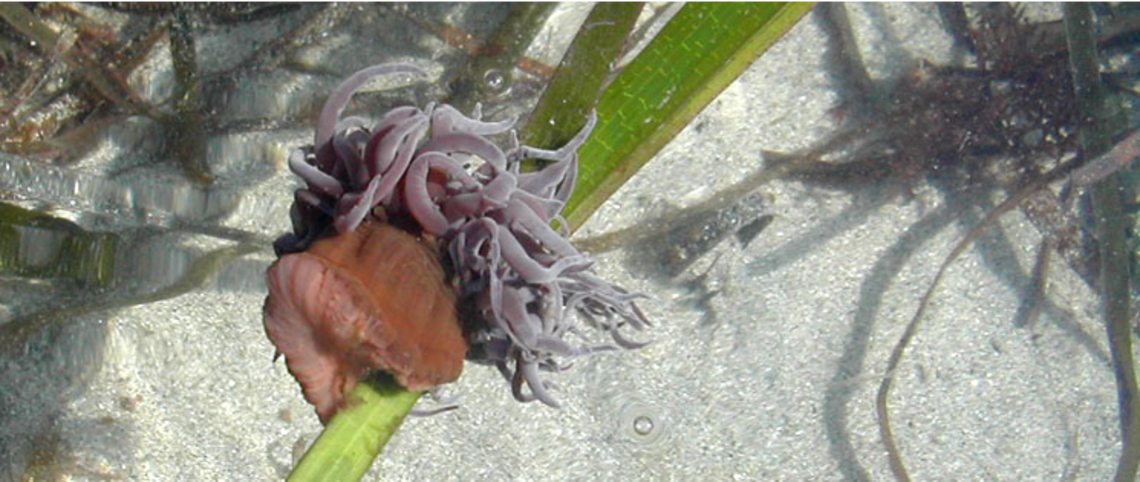
Lanice conchilega reef
Biotope description :
This biotope usually occurs on flats of medium fine sand and muddy sand, most often on the lower and mid shore. The sand may contain a proportion of shell fragments or gravel. Lanice can also occur on the lower part of predominantly rocky or boulder shores, where patches of sand or muddy sand occur between scattered boulders, cobbles and pebbles. Conditions may be tide-swept, and the sediment may be mobile, but the biotope usually occurs in areas sheltered from strong wave action. The sediment supports dense populations of the tube-building polychaete Lanice conchilega (Pallas, 1766) or sand mason. Other polychaetes present are tolerant of sand scour or mobility of the sediment surface layers and include the polychaetes Anaitides mucosa, Eumida sanguinea, Nephtys hombergii, Scoloplos armiger, Aricidea minuta, Tharyx spp. and Pygospio elegans. The mud shrimp Corophium arenarium and the cockle Cerastoderma edule may be abundant. The baltic tellin Macoma balthica may be present. On boulder shores, and where pebbles and cobbles are mixed in with lower shore tide-swept sand with dense L. conchilega between the cobbles, the infaunal component is rarely sampled. The infaunal community under these circumstances, provided that the cobbles are not packed very close together, is likely to be similar to that in areas without the coarse material.
In Belgian waters, L. conchilega is the key-species of the Abra alba, Mysella-bidentata community. The biodiversity of the A. alba community is on average an order of magnitude higher (species richness: x 4 – x 6; macrobenthic density: x 7 – x 34) (Van Hoey et al., 2004; Degraer et al., 2002) compared to the other communities occurring on the Belgian part of the North Sea. The bioherm structures may further double to triple its biodiversity estimates (species richness: x 2; macrobenthic density: x 2-3) and often the term ‘Lanice reef’ or ‘sand reefs’ is used.
Key-words :
sand
Habitat description :
In Belgian waters, dense Lanice bioherms can contain up to 10000 protruding (up to 4 cm) polychaete tubes. The tube consists of medium-sized to large sand grains with a characteristic fan shape at the top. Direct measurements in the lower intertidal of Belgian sandy beaches revealed that Lanice bioherms had a patch size of 1 to 10 m˛ and elevated 15 to 20 cm above the surrounding sediment. These high-density patches were scarcely spread throughout the lower intertidal and covered no more than 10 % of the total area. Individual Lanice bioherms can thus be depicted as small-scale patches in a generally flat soft-sedimented environment. In the subtidal, high-density patches of Lanice (from 1500 to 10000 ind. Lanice/m˛) are also found. Lanice conchilega is found in various types of sediments, but displays a preference for fine to medium-grained sands (100 to 500 µm) with a relatively high mud content (10 to 40%).
Description :
Dense Lanice conchilega biocenosis
Comments :
Apart from two rocky outcrops (R), all the sedimentary deposits seen on this sonar image are coarse fractions: coarse sand, gravel or shingles (C. Sed.). They are shown by high backscattering which is dark-coloured with a reversed palette. However, a dense Lanice conchilega biocenosis appears in the centre and at the top of the sonogram. This fact is borne out, on one hand by the acoustic irregularity of the seabeds colonized by the species and on the other hand by the exclusive presence of very orderly megaripples on the areas whose sediment is entirely free of any biocenotic settlement of this type on the surface.
Technique(s) :
Backscatter images
- Type
sidescan
- Make & Model
EGG – SMS 960
- Operating frequency (kHz)
105
- Total swathe width (m)
100
- Approximate water depth (m)
10
- Gray level (positive or negative image)
negative image
Date : 19/08/1983
Date accuracy : Day
From : Auffret et al., 1986
Contact email : Axel.Ehrhold@ifremer.fr
Data owner : Ifremer